
 Historic Medley District
HMD SPEAKER SERIES–Skip Etheridge, Sugarland Ethno-History Project
April 7, 2019, Old Town Hall, Poolesville, MD
“From Sugarland to the National Mall in Washington, DC: How the African-American Communities in Poolesville have impacted our Nation.”
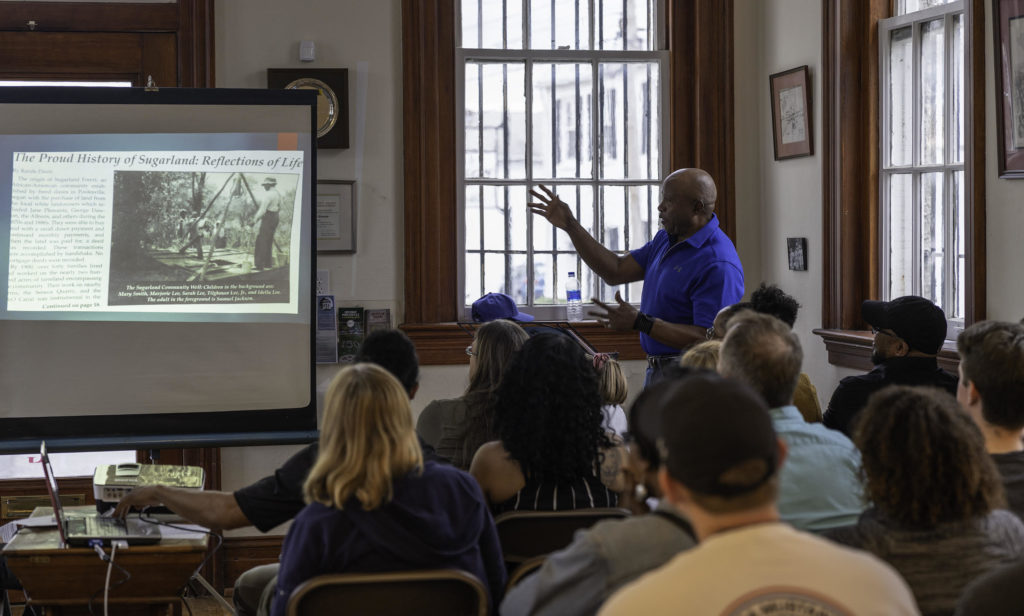
History Should Not Be Forgotten by Maureen O’Connell
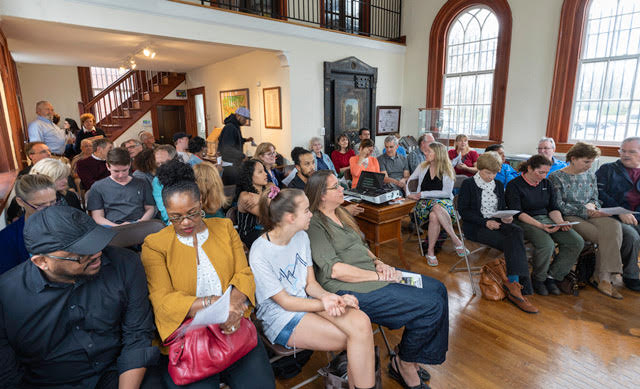
Historic Medley District, Inc. continued their Speaker Series on Sunday, April 7, 2019 hosting James “Skip” Etheridge who spoke about Sugarland and how the African-American communities in and around Poolesville affected the region and the nation. Etheridge, a descendant of one of the founders of the Sugarland community, is a retired Maryland state trooper; his father had been a D.C. police officer. He began his talk by saying that “he is so attached to Sugarland. It is his family, family land, and family heritage. It is very important to me.” Today we shall “ ‘pull the bandage off’; we are going to talk about slavery. We can’t be afraid to speak about it. It is our history.” Some people are uncomfortable speaking about this subject, as the past has the uncanny ability to disrupt the present.
Poolesville is ringed by areas where plantations once stood. After the Civil War, these lands were deeded to freed slaves. Many people pass through these streets every day and they don’t know the history of those who lived there before. Let’s look at the founding of these five regions: Sugarland, Jerusalem, Big Woods, Martinsburg, and Jonesville. They were not only ‘home’ for these men, women and children, they were important contributors to the economic and social stability of Poolesville.
Many of the black communities were tight knit, rural, and centered around school and church. The Sugarland Forest Community was established by freed slaves after emancipation. Patriarchs William Taylor, Patrick Hebron, Jr., and John Diggs, as trustees, purchased this parcel of land from George W. Dawson, a former white slave owner, on October 6, 1871 for the $25.00. It was specified in the deed that the land be used for religious worship, a school, and a burial site for people of African descent. The heart and soul of Sugarland resided in the St. Paul Community Church on Sugarland Road in Poolesville. Skip Etheridge is the great, great grandson of William Taylor, one of the three founding fathers of the church. The history of Sugarland cannot be told without the name of Gwen Hebron Reese, a direct descendant of the town’s founders. She grew up there in a wood-frame house built by her father, a direct descendant of freed slaves. “Sugarland was a community born out of slavery,” Reese said. In 1995, she, her cousins, and other descendants of the founding fathers, organized the Ethno-Historic Project to document the African-American community of Sugarland. Its mission is to promote and highlight the experience of the African-American from slavery to the present day. The organization has collected more than 1,000 artifacts and documents that shed light on the daily lives of the people living in the Sugarland community.
Traveling in or out of Poolesville, you pass Jerusalem Road, just off Route 109, the Beallsville – Poolesville Road. This area, being in a central and easily accessible location for many in the black community, played an active presence in their lives. The Jerusalem Baptist Church and Cemetery were the centerpiece and many of the founders of the community art buried there.
The church celebrated its centennial in 1974, making it one of the oldest rural Black churches in the county. An interesting footnote to the history of Jerusalem is what we now call the “Beauty Spot,” one of Montgomery County’s solid waste disposal centers. On this piece of land was a Rosenwald School, one of more than 5,000 state-of-the-art schools, shops, and teachers’ homes in the U.S. built primarily for the education of African-American children in the South during the early 20th century by Booker T. Washington of the Tuskegee Institute and Julius Rosenwald, philanthropist and President of Sears and Roebuck. This effort has been called the most important initiative to advance black education in its time. By 1928, one third of the South’s rural black school children and teachers were served by Rosenwald schools and only a small percentage of Americans are familiar with their impact on our nation’s history. /—/
Just off Route 109 between Poolesville and Beallsville, was another large black community, called Big Woods. Founded in 1813, it was one of the oldest in the area and was home to many slaves.
Another vibrant African-American community was Martinsburg, located on White’s Ferry Road. Its center was the Warren Historic Site, and it is the last such site in Maryland to retain all three of the structures that were the heart of the community: the Warren UM Church (built in 1903), the one-room Martinsburg Negro School (built in 1886), and the Loving Charity Lodge Hall (built in 1914).
North of Poolesville off Route 28, you will find the area that used to be known as Jonesville, an early black settlement. It was named in honor of its founders, brothers Erasmus Jones and Richard Jones, who bought the land for $135. Researchers have said that the Jones brothers were former slaves whom they believed worked at a nearby plantation, called Aix la Chappelle. One of the homes in Jonesville, the Jones-Hall-Sims house built by Richard Jones in 1875, lives on today as a testimony to its history, in the Smithsonian’s National Museum of African American History and Culture. Acquired in 2009, the home was stripped down from 140 years and additions and siding and was rebuilt as part of an exhibition called “Defending Freedom, Defining Freedom: The Era of Segregation.” The house was very distinctive in its time as it was a two-story structure; it stood apart and separate from what would have been thought of as a slave cabin.
Etheridge emphasized many time that “education is the key to freedom,” especially for black children. In 1954, the Supreme Court ruled in Brown v. Board of Education that segregation in public schools was unconstitutional. After that, Rosenwald Schools became obsolete. But that did not remove bigotry against black people from many people’s minds. In 1956, a year after Montgomery County integrated public schools, Poolesville integrated its schools. George Barnes, Jr. was one of eight students who was escorted by policemen into the Poolesville school. These guards also closely followed him and his friends down the school halls and back home. Demonstrations against racial integration by the town people went on for days. Tensions continued into 1957. Connie Morella, who would later become a Congresswoman, taught English and Civics at Poolesville High School. She said, “The people in Poolesville are all wonderful people, but they just could not understand integration.” Black students in many areas of the U.S. did not begin to enter predominately white schools until the mid -1960’s.
Etheridge closed his talk saying that “ black people brought life to the economy and the social fabric of the Poolesville community.” Many small towns were built by ex-slaves, but he reminded us that “they were all Americans.” We have come a long way, but our journey is not finished. “History must not be forgotten. It is our history – our town.”
We continue our Speaker Series in April with a talk by Skip Etheridge, a descendent of one of the founders of the Sugarland community. The small settlement of Sugarland was established in 1871 by freed persons who purchased the land after emancipation. In his presentation, Mr. Etheridge will discuss the history of the Sugarland, how it impacted the region, and how it is now presented on the National Mall at the Smithsonian’s National Museum of African American History and Culture.
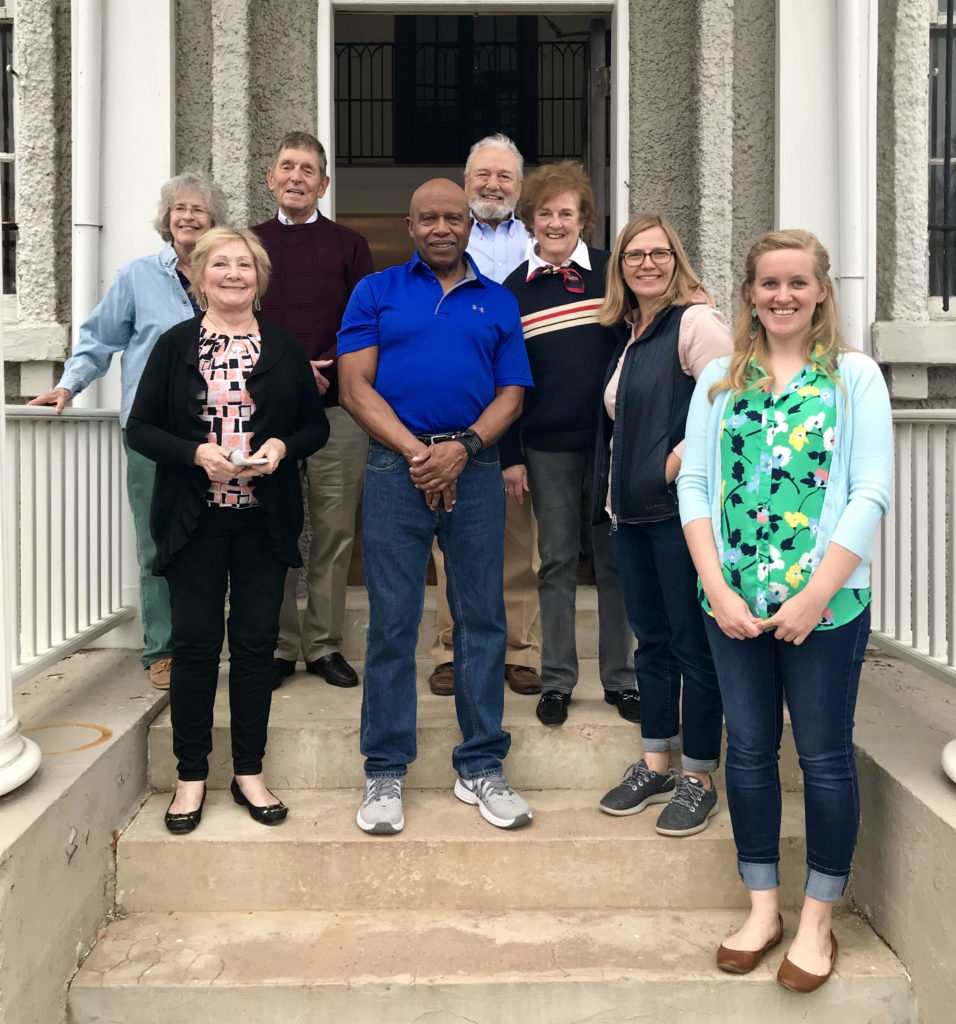
Speaker Skip Etheridge, center, with HMD Board–Jean Findley, Treasurer, Sharon Baurer, Vice President/Secretary, Chet Anderson, John Pentecost, Maureen O’Connell, President, Abby Clouse and Elisa Graf.
I truly enjoyed learning more about the history of Sugarland as it relates to my family. My uncle gave a fantastic presentation, his ancestors would have been proud…I am!
I loved your speech, great job.